Friday, August 2, 2013

Learning from Complex Texts...and Laura Robb!

Rockstar teacher, writer, researcher, and presenter Laura Robb came to the fair city of Lebanon, OhioLebanon, Ohio to bestow her knowledge of the Common Core in reading and writing to a group of intermediate and middle school teachers from around the area on Thursday and Friday.  What a two days it was!  My friend Holly Mueller and I were lucky enough to attend both days and we learned so much!

We started Thursday with her new book Unlocking Complex Texts.  
I'm so excited to dig into this one.  She's set up the book by genre studies and provides readers with anchor texts and materials, guided practice texts, independent texts, and additional materials.  There is even a CD included that has the materials in it that you might want to copy when you try out some of the units.

One of the first things Laura talked about was how kids should be reading 40-60 books per school year.  This goes hand-in-hand with Donalyn Miller's philosophy of the 40 book challenge, which I use every year in my classroom.  There is no reason students can't strive to read this many books in a year.  However, we must give them time to read at school and expect them to read at home, too.  Laura emphasized that there is no reading homework in her class, other than to read.  She touched on the excitement that can be contagious in a reading classroom that has a teacher that facilitates a love and appreciation of reading in daily life.  She suggested that each child give one book talk per month to help other students find new books.  This is an idea that is mentioned in almost any professional text about teaching reading.  Kids love to get suggestions from other kids.  When you foster that type of environment in your classroom, you will garner a large number of excited readers.

After this introduction, Robb went on to present to us the use of a concept map.  She used the word "devastation".  This is more than a vocabulary exercise.  She put the word in the middle of the paper and had an audience member tell something that was devastating.  She then further prompted the person to explain how that particular thing was devastating.  By doing this in front of the entire group, everyone heard the story and had a better understanding of what the word "devastation" meant.  We went back to this concept map throughout the day and added ideas to it.  Going along with the devastation theme, we read two short nonfiction pieces that centered around a type of devastation.  Both pieces were by Jim Murphy.  One was about the great Chicago fire in the 1800s and the other piece was about the Blizzard of 1888 in Harlem, NY.  Both were high-interest, narrative nonfiction.  The emphasis for this part of the workshop was close reading.  If you know anything about the Common Core, you know that close reading (reading closely to learn new information and slowing down) is a huge part of it!  Here's how Laura presented it:

1. Preview the text by reading aloud the first and last paragraphs.  Then, have kids write down anything they could remember about the two paragraphs (basically, kids are bullet pointing important information they heard in the two paragraphs).
2. Set a purpose for reading--this is a lot like determining importance.  What do you want to know about while reading this text?  It's important for the students to set a purpose themselves, resulting in several different purposes around the room.  Students need to have a vested interest in what they're reading.  I love this!  So often, I set the purpose and now I can turn that over to my class.
3. Read the text through completely, SILENTLY.  This is crucial.  Students must have time to read silently and undisturbed to absorb what they're reading.
4.  After kids have read the text through completely, you discuss the "gist" of the text with them.  Then, you can turn this gist into a theme statement.  

From there, Laura has developed discussion questions that get kids talking about the text and defending their claims with evidence from the text.  These can be jigsawed throughout the room.  She has also developed multiple choice quizzes to go along with the texts that mirror those that will be found on the PARCC assessments.  My favorite part of all of this (other than its accessibility), is that after the students take the quiz, she expects them to pick one question and defend their answer in a paragraph.  In other words, students must find evidence from the text that proves their answer is correct.  This is not only critical thinking, but it makes students put their thoughts into writing.  I can't wait to try it out in my room!

On Friday, we focused on writing and boy, was it difficult!  We all know Common Core is rigorous, but this really showed us exactly how rigorous it will be!  We got lots of scaffolding and practice, though, and Laura was right there guiding us through each step of the process.  I loved doing argument writing and I'm so excited to try it out with my fifth graders this fall.

We started the writing workshop by learning that a claim has a yes/no perspective.  Sometimes you can argue either yes or no, but often just one or the other.  We read a fascinating article entitled, "Dust Bowl Disaster" and made a claim based off it.  She then guided us through writing an introduction for our essay, citing evidence from the text (which should be paraphrased, not quoted directly!), and writing a conclusion.  While this seems fairly simple, put yourself in a 6th or 7th grade classroom and reconsider. It took a group of writing teachers a long time to fully grasp the complexity of this type of writing.  Kids will need a lot of modeling and guidance.  But, it was fun!  When we finished, we felt so accomplished.  After lunch, we read three texts that were related in some manner (a poem by Langston Hughes, an excerpt of Frederick Douglass's memoir, and a riveting story about a modern-day childhood slave in California).  On our own, or with our table, we had to create a claim, an introduction, cite evidence from the text, and a conclusion, along with a working title.  Talk about close reading text for meaning and comprehension!  We referred back to the texts often and came up with a pretty decent essay.  Again, I'm so excited to try this close reading and writing with my classes this fall.  

Laura Robb is an amazing woman who is obviously passionate about teaching kids and educators.  She was a wealth of knowledge and guided us every step of the way.  I now have a better idea of how to approach close reading a text and of how to teach one of the three major types of writing for CCSS, the argumentative essay.  Thank you Laura and Warren County ESC!

Monday, July 29, 2013

It's Monday, What Are You Reading?

It's Monday, What Are You Reading?

I'm officially picking up this meme today and will be posting my reading each Monday hereafter.  I'm excited to take part in an iniative that encourages reading and sharing with others.  Thanks to Teach Mentor Texts and Book Journey who originally started the meme.  I'll be reviewing picture books, middle grade books, and adult books.  I'd love to hear what you're reading, too!

 Last week I finished a couple of fun books.  This is a bit of  repeat list from my last blog post, but I added a couple more things.

PICTURE BOOKS


Another cute installment in the Otis collection. The farm animals are afraid of the bull on the farm because he is not kind to them. When a tornado strikes, however, the bull is scared and Otis comes to his rescue.  This was one my almost four-year-old daughter picked out at the library.  We have the original Otis at home and she was super excited to read another Otis book.  We also borrow Otis and the Puppy.  We haven't read it yet, but I have a feeling it will be read soon!


The Princess and the Potty by Wendy Cheyette Lewison

This book might be the turning point in our quest to potty train said daughter mentioned above.  She very much relates with the princess who does not want to use the potty in this book.  However, she ASKED for a pink potty and now has it in her room.  She is actually excited about the thought of using it.  It's been a very thrilling 24 hours in our household...

Odd Owls and Stout Pigs by Arnold Lobel

This is a fun collection of poetry written for young children about owls and pigs doing zany things and acting in nonsensical manners.  Natalie loved it!  It's got a nice lull to it and it's fun to read.


MIDDLE GRADE/YOUNG ADULT


What I love about the Hattie books are the strength and determination of a young woman in the early 1900s. Hattie left Montana in the first book and ventured to San Francisco in the second book to follow her dream of being a reporter. She's a plucky, self-sufficient female that doesn't have to rely on the good graces of men to find her way in the world. Bravo Hattie and Kirby Larson!


CURRENTLY READING


CURRENTLY LISTENING TO


I'd love to know what you're currently reading and or listening to!  Leave a comment below.  Happy reading!

Friday, July 26, 2013

Late Summer Reading Round-Up 2013

This has been a busy summer for me!  I took a four week course at Miami University through the Ohio Writing Project (which I blogged about previously), a did a day writing retreat in Hocking Hills, OH with Choice Literacy, I'm gearing up for a professional development presentation I'll be attending for two days next week presented by Laura Robb, and oh, yeah, school starts in about three weeks.  It's been a summer full of writing, reading, and thinking.  I thought it would be fun to take a look at what I've read so far this summer.  There is a mix of picture books, middle grade novels, young adult books, and adult literature.  Peruse at your leisure.  I would love to know what your favorite book or two have been this summer (so far--there are three weeks left, after all!).

1. Rump: The True Story of Rumpelstiltskin by Leisl Shirtliff

I loved this book about Rumplestiltskin's background! Rump is a poor boy living in the Mountain area of his kingdom. His mother died shortly after his birth and his father was already dead. His grandmother raised him until she died when Rump was 11 or 12. Right before his grandmother's death, Rump discovers his mother's old spinning wheel in the wood pile. He brings it in and his grandmother vehemently discourages him from using it. Not surprisingly he doesn't listen and he's soon spinning gold. Spinning gold gets him into some binds, but takes him on an adventure to find the rest of his name (which will reveal his destiny) and his lost family. I think I'm going to start the year with this. It's got everything a 5th grader will love: humor, solid theme, play-on-words, and symbolism, but it's done in a very age-appropriate manner. This is a great read!


2. The Colossus Rises by Peter Larangis

I give this one 3.5 stars. I think kids would give it 4 or 5 stars. The story is full of action, very similar to a Rick Riordan read. I liked the premise that it's based around the seven wonders of the world. There is so much fantastical action that I had trouble keeping up and I often found my mind wandering. The end of the book just cut off, without wrapping up loose ends. Obviously, the next book will pick up right where this one left off, but I'm not a fan of just cutting off a story. I think I could certainly recommend this to kids that love the fantasy/sci-fi genre and kids that love Percy Jackson or The Red Pyramid series.


3. Out of My Mind by Sharon Draper

Somehow, I'd never read this entire book! It was wonderful. Melody is stuck in a wheelchair and cannot talk, but she can think and yearns to speak. She convinces her parents to buy her a medi-board, which allows her to type (with one thumb only) words that the board can speak for her. Melody experiences a whole new world when she can use her talking board at school. She even makes the quiz team and they qualify for a trip to Nationals in Washington D.C. Then, tragedy strikes and Melody has to decide who her real friends are and what it means to be loved.


4. The Unwanteds by Lisa McMann

I enjoyed this first book in the Unwanteds series. In a nutshell, a group of children is selected every year as "unwanteds" because they've somehow demonstrated some form of creativity in an society that does not value creativity. Said children are sent to a "death camp", which proves to be a lovely world filled with creative artists. The book focuses on a group of kids fighting against their "home" country of Quill when the Quillians discover that the death camp isn't a death camp at all. Reminded my a lot of an updated version of Harry Potter.


5. Doll Bones by Holly Black

A story of three kids on the brink of adolescence who have a last adventure together and try to find their way in the ever-changing world of tweendom.


6. Matched by Ally Condie

Wow! This is one of the best young adult books I've read (listened to) in a long while! Cassia lives in the society and is matched at age 17 (through genetics) to her best friend Xander. However, when she consults her microchip to learn more about Xander, Ky Marcum's picture comes on the screen, leading Cassia to become curious about her match. Was she really supposed to be with Xander, or is she destined to be with Ky? More than a love story, this is an intriguing look at what the world has become and how controlled its citizens are. I would love to read this book with a group of middle school students and have a discussion about the society in which the characters live.


7. Hattie Ever After by Kirby Larson

What I love about the Hattie books are the strength and determination of a young woman in the early 1900s. Hattie left Montana in the first book and ventured to San Francisco in the second book to follow her dream of being a reporter. She's a plucky, self-sufficient female that doesn't have to rely on the good graces of men to find her way in the world. Bravo Hattie and Kirby Larson!


8. Otis and the Tornado by Loren Long

Another cute installment in the Otis collection. The farm animals are afraid of the bull on the farm because he is not kind to them. When a tornado strikes, however, the bull is scared and Otis comes to his rescue.


9. The Princess and the Potty by Wendy Cheyette Lewison

This is a great book about a princess that has no desire to use the potty (sound familiar?). She decides to go potty on her own terms. Gives me a speck of hope...
This will be especially meaningful for any of you that know me or my husband and our struggles with potty training our soon-to-be four year old (yes, you read that correctly).

10. And the Mountains Echoed by Khaled Hosseini

I LOVED this book about a brother and sister separated at an early age and all of the people in their lives that intertwined bringing about their eventual reunion. One of the best books of 2013!


This list pales in comparison to other summers, when I was a reading machine.  However, I've devoted copious amounts of time this summer to writing.  Trade-offs, right?  I do plan on getting a few more books in before school starts.  And, of course, reading never stops.  I'll be reading right through the school year.  

Leave a comment and let me know what your favorite summer read has been, be it picture book, early readers, middle grade books, YA, or adult.  I'm always looking for books to add to my ever-growing "to-read" list.  Happy Reading!


Tuesday, July 9, 2013

Top 10 Ways to Turn Your Classroom into a Hotbed of Enthusiastic Readers

On Sunday, Holly Mueller and I were guest bloggers on The Nerdy Book Club blog.  Holly blogs regularly at Reading, Teaching, Learning.  We co-wrote the following article about turning your classroom into a "hotbed" of reading enthusiasm.  It was so much fun to co-create the piece!  We're looking forward to writing more together.

If you've never checked out Nerdy Book Club, you need to scoot on over!  It's a great site that is full of enthusiastic teachers, librarians, and people interested in education.

Click Here!


We are intermediate grade teachers who have learned over the years that there are practices that get kids excited about reading.   We tried to rank them but decided they were all equally important.  We can’t imagine eliminating any of them, so these are not in any particular order.
1.  Know your kids.  Did Katie’s hamster die last night?  Is Michael upset because his parents are getting a divorce?  If you know your kids, you can connect readers with books.  LOVE THAT DOG may help Katie express her feelings about her beloved pet.  BIGGER THAN A BREAD BOX may help Michael see his parents as people and forgive them.  Books speak to our students.  Keep students in mind when you read books.
2.  Read aloud EVERY DAY. We know there is not enough time in the day for all you have to do.  But don’t give up reading aloud.  It builds a reading community (and vocabulary, fluency, and a sense of story) and provides touchstone texts.  Reading aloud creates a bonding experience and time to be together in another world.  It provides numerous opportunities to model good writing and teach reading strategies.   And it’s fun!
3.  Invite authors into your classroom and school.  If you can’t get them to come in person, Skype, Twitter, blog, and e-mail them in!  Treat authors like they’re rock stars!  Meeting authors gives students a glimpse into a writer’s world and just may inspire them to become writers themselves!  We have found children’s authors to be extremely kind, creative, and interesting people!  Use social media to connect to authors and educators.  It’s inspiring to be part of that positive online community.
4.  Be a wide and voracious reader yourself.  We couldn’t put this any better thanKatherine Sokolowski and her students did in her own Nerdy Top Ten.  We believe this is the number one reason why we are getting better as reading teachers.  We are more and more passionate and knowledgeable about children’s books at all levels, genres, and formats.  The kids see that and are moved to action by it.
5.  Give students choice with frameworks.  Students should be allowed to choose what they read as much as possible.  Eliminate or at least limit whole class book studies.  We find that read alouds substitute as whole class novels and can provide common mentor texts for all kinds of purposes.  Even when choosing books for small group studies, we give them choices.  A framework like reading contracts (contracts given every month, focusing on a theme topic or genre that incorporates choice reading and CCSS) gives students direction in their reading.  We feel uncomfortable when students are only reading what they want to read and there isn’t any direction.  When we job-shared, we chose to go without contracts for one year and found that student reading was difficult to track and connect to other reading.  Contracts frame their reading into genres, theme topics, and /or book formats so they are challenged to read widely and deeply as well as voraciously.  Keep in mind that the kids are also expected to read independent books that are COMPLETELY their choice along with their chosen required books.
6.  Institute Donalyn Miller’s 40 Book Challenge.  This is another idea we’ve incorporated into our classrooms that has made a huge difference.  THE BOOK WHISPERER is a must-read when teaching reading.  We were skeptical at first because 40 books sounded like a lot of books in our pre-reading-hotbed days.  However, it was successful the first year.  The 40 Book Challenge is a work in progress.  We are continually tweaking it to fit our readers and to reflect what we’re learning.  Make the 40 Book Challenge your own, but whatever you do, don’t overlook or underestimate its power to encourage students to read.
7.  Build a classroom library and bring books TO students.  Recently, a student was helping one of us pack up books to move to a new classroom.  She said, “You have OBBD.  Obsessive Book Buying Disorder.  But that’s not a bad thing!”  Kelly Gallagher tells a story in his book READICIDE about trying to book talk a memoir by Lois Duncan chronicling her daughter’s murder.  He knew it was high interest, and he knew a lot of students had seen I Know What You Did Last Summer.  The library had 3 copies; Gallaher had none.  The only way he could get kids to check out the books was to bring them into the classroom to the kids. Immediately providing books to students in the classroom is one of the cornerstones for happy readers. We’ve spent years building healthy-sized classroom libraries. When multiple copies or new titles are needed, and you don’t have them in your library, check them out yourself at a library and bring them into the classroom.  Do we lose a few?  Yes.  Is it worth it?  Yes.
8.   TALK about books as well as write about them.  Be as “real life” as possible.  When was the last time you made a diorama when you finished a book?  AtDublin Literacy Conference, Donalyn Miller said, “I’m not a language arts and crafts teacher.”  What DID you do the last time you finished a book?  You probably wrote or talked about it!  There is lots of material to cover with CCSS, but we can do it authentically.  Do we sometimes ask questions on a worksheet or do projects?  Yes, but there are many ways we assess.  Kids want to talk to each other and to YOU about what they’re reading!  Give them free writing and talking rein when possible.  We get more authentic responses to books when we give kids less parameters.  Do they need to practice writing from prompts?  Yes, but they also need to practice writing about what THEY want to say.
9.  Offer book clubs.  Kids don’t need rewards for reading like points, prizes, and parties.  However, they love book clubs.  We’ve run Mock Newbery and Caldecott clubs, parent/student book clubs (one even took place at the Cincinnati Zoo after reading THE ONE AND ONLY IVAN), and pledged to “Choose Kind” after reading WONDER.  Parents have eagerly snapped up multiple copies of our read alouds to read and discuss with us and commented on classroom blog conversation starters.  Students have told us they were proud they got their parents to read.  How many of you belong to book clubs?  Kids love them, too!
10.  Let kids read silently every day.  OH, this can be so hard!  We have so much to do!  However,  studies show that there is no greater way to increase stamina, fluency, vocabulary, writing skills, background knowledge, a sense of story, lifelong reading, and pure enjoyment.  Besides, how are you going to know your students’ reading habits, struggles, preferences, and successes if you don’t see them read??
Did we cover them all?  We doubt it.  We’d love to hear about any other practices that you think create classrooms of enthusiastic readers!


Sunday, June 30, 2013

Summer Adventures

For the last two weeks, I've been taking a class about teaching writing at Miami University, sponsored by the Ohio Writing Project, which is an extension of the National Writing Project.  OWP has given my time to work on some writing I'm doing with my good friend Holly Mueller.  We're working on a professional book about literacy in intermediate grades.  We get an hour of writing time each morning in class and I'm trying to take full advantage of using it for our book.  An hour of writing each day!  That's something I rarely give myself.  It's been great!

On Friday, I had to give a 90 minute interactive demonstration to my fellow OWPers.  It's one of the requirements of the class and it was so much fun!  I centered my presentation around writing narratives/memoirs.  I  have found that, in the past, my students struggle to write a story about a time in their lives without explaining more than necessary.  This year, I attempted to have them zoom in on a specific part of a story they wanted to tell.  I had great results with it and the kids enjoyed all of the different writing they got to do.  I used three mentor texts to help guide my instruction.
Looking Back by Lois Lowry

Marshfield Dreams by Ralph Fletcher
Knucklehead by Jon Scieszka

We do many different types of writing with these books.  But before we start reading these famous authors' books, we read two picture books:
Grandpa Green by Lane Smith
Wilfrid Gordon McDonald Partridge by Mem Fox

After reading these two books, the kids write about a special time they spent with someone older than them.  Then, we move on to the three memoirs written by well known authors.  I read a variety of stories to them, centered around the same themes  For example, one day we read funny stories from our mentor texts, one day we read stories about home, and one day we read stories about changing and growing up.  Another fun thing to throw in is what groceries for a week looks like around the world.  We talk about what we notice and where we would like to travel and where we're glad we don't live.  Then, students write about a food memory.  This is one of the most powerful stories they have.  It's also the one I chose to take into a longer piece.  Reading stories and doing short writings based off them is an easy, nonthreatening way to get kids engaged with writing and not overwhelmed by the idea of it.

After we have done a two weeks of idea generation for various memories, we choose one or two that we think we can make a decent story out of.  We talk about the elements of story and what we think our stories should or should not include.  Once the decision about which piece to work on, I have the kids draw a circle and divide it into six slices (like a pizza).  In each slice, they have to chronologically place an event in their story.  Here's what mine looked like:
My food memory was of traveling to Japan to visit my sister-in-law and all of the interesting food options we encountered there.  After I modeled this, my class did they same thing with their memories.  When our "pizzas" were filled in, we each chose ONE slice that we zoomed in on for a longer piece.  I chose slice #2, eating a breakfast of rice with fish flakes.  Ugh.  Again, here's what mine looked like (I wrote in front of the class so they could see how it looks to struggle with getting your ideas onto paper).
I copied this into my writer's notebook, added more to it.  The kids did the same with their own writing.  Once we had a good handle on the story, I modeled some revision techniques (always a hard thing to get young writers to do--that's why teachers have to model, model, model).  My notebook was full of crossed out lines and carrots indicating new lines that needed to be added in. 

Unfortunately, our time ran out because we did this at the end of the school year.  My classes had really great starts of memoirs.  I plan on doing this FIRST this coming school year.  It was such an engaging unit and our kids have SO MUCH to SAY!  

How do you incorporate narrative into your school year?  Leave a comment below.

Friday, June 7, 2013

End of Year Wrap-Up

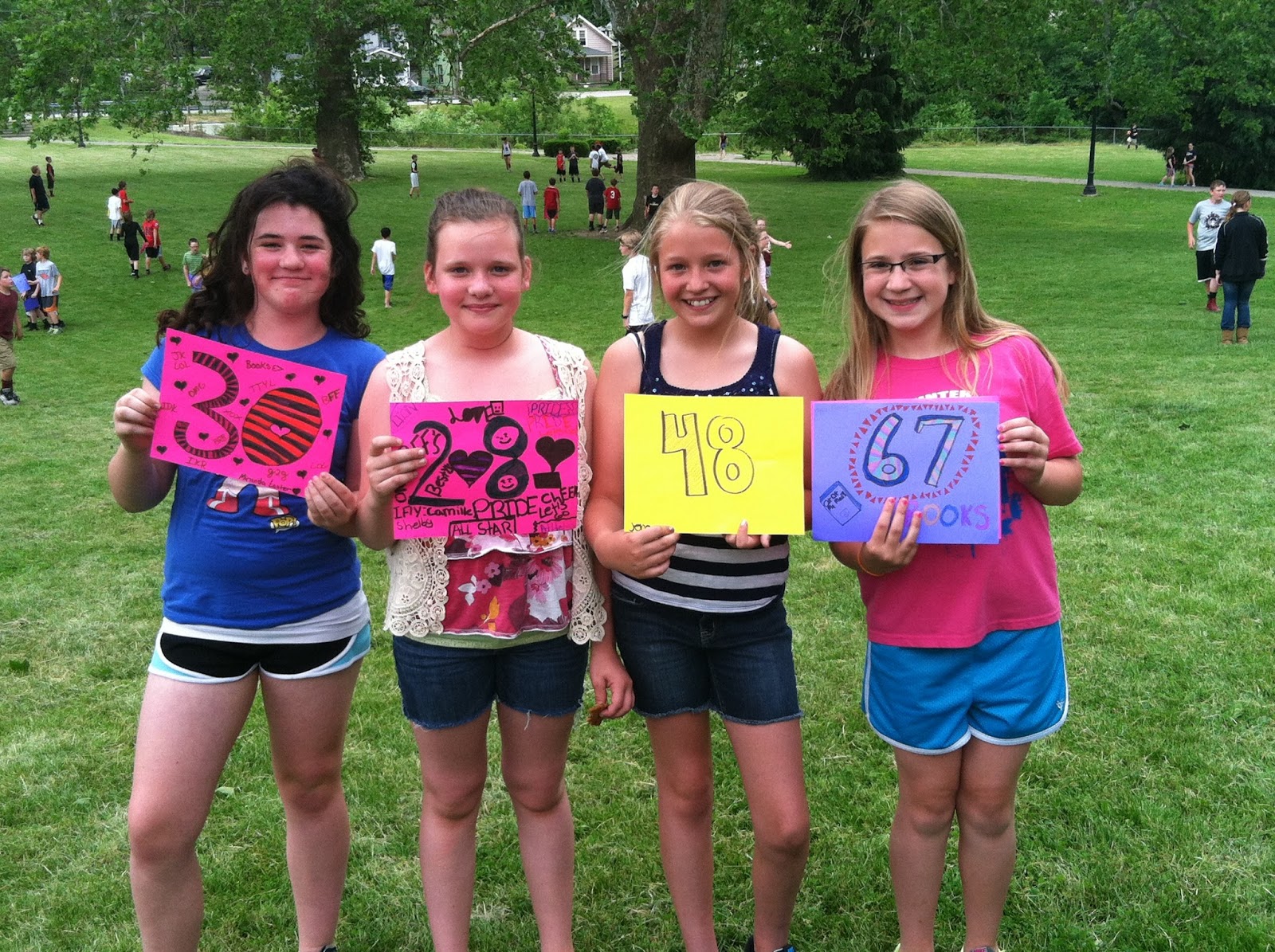
Another school year has come and gone.  This was my first year back full-time since having my daughter (who will be four in August).  I job-shared for three years with the talented Holly Mueller.  You can check out her blog at www.hollymueller.blogspot.com.  In this first year back, I was really able to dig deep and know more about my students and their reading lives.  I started the year by presenting my version of Donalyn Miller's 40 Book Challenge.  I called it the 40 Book Invitation and invited my students to attempt to read 40 books this school year.  I had a wide range of readers, from gifted to emerging.  However, over half of the kids in each class (I teach two LA classes) read 40 books or more.  A significant amount read 30-39 books.  How very exciting!  It was almost unanimous that students read more this year than any other year.  Plus, we all made summer reading lists and talked excessively about summer reading the last few days of school.  And that, my friends, is what teaching reading is all about--a little motivation, mixed with some enthusiasm, and a dash of challenge.  These kids rocked!  (And, I'll really miss getting and giving recommendations from them over the summer!)


Each class read over 1000 books!  AMAZING!!

So, I can't figure out how to rotate this on the blog.  Turn your monitor sideways for a second...

I invite you to entertain the thought of challenging your readers in the upcoming school year.  Do it by page numbers or books, but do it!  Expect them to live a reading life.  They'll surprise you with the their enthusiasm, desire, and results.  Go read books this summer so you can become a "book whisperer" too!  

Sunday, May 19, 2013

Adventure #5-More Conflict, with a Twist

One of our big focuses this year was to take conflict in literature a step further so students could really understand the plot of a novel and then apply it to the world in which they live.  After all, the heart of all disputes is conflict.  And what would good literature be without it?  By being aware of and analyzing conflict, we can better understand the character (s) motivations and why characters act the way they do.  The next step, is to apply that same form of thinking to real life.  Why do people act in certain ways?  What motivates them to respond in the manner they do?  How can we learn about our past by studying the conflicts in it?

This was the premise of the project I created for my accelerated readers.  I knew they could tackle reading an extra book (in addition to their reading contract books--which is a whole other blog entry that I will tackle later).  Students had to choose a historical fiction book about a time period they found interesting.  Many students chose World War Two and the Holocaust.  We've talked about Hitler throughout the year (in our revolutionary thinking unit and in our government unit in Social Studies).  We watched several book trailers on YouTube and I book talked several books in my classroom library--historical fiction happens to be one of my favorite genres.  Students made their book selections and wanted time to read.  When they were done reading, they wrote a book review that focused heavily on the conflict of the story and if they felt the author did an adequate job portraying that conflict through the actions of the characters.  After they read and wrote the book reviews, students then had to find an article relating to the central conflict of their story.  For example, if they read a book about the Holocaust, they had to find an article about the Holocaust.  Students did this through internet searching.  They found some interesting stuff!

Below, I've linked a PowerPoint presentation that one of my students created to share with the class to show the similarities and differences between the book and article and the conflicts each presented.  Students had free range of how to present their findings.  Some did a written report and orally shared their finding with the class, some did PowerPoint presentations and shared with the class, and some created posters to share.  This particular PowerPoint demonstrated the linkage between the book and article quite well for a 5th grader.  I was impressed and so very glad I challenged them to take their learning to the next level!

Check out this great Power Point about the book The Boy Who Dared.  The Boy Who Dared Power Point Presentation