Tuesday, July 9, 2013

Top 10 Ways to Turn Your Classroom into a Hotbed of Enthusiastic Readers

On Sunday, Holly Mueller and I were guest bloggers on The Nerdy Book Club blog.  Holly blogs regularly at Reading, Teaching, Learning.  We co-wrote the following article about turning your classroom into a "hotbed" of reading enthusiasm.  It was so much fun to co-create the piece!  We're looking forward to writing more together.

If you've never checked out Nerdy Book Club, you need to scoot on over!  It's a great site that is full of enthusiastic teachers, librarians, and people interested in education.

Click Here!


We are intermediate grade teachers who have learned over the years that there are practices that get kids excited about reading.   We tried to rank them but decided they were all equally important.  We can’t imagine eliminating any of them, so these are not in any particular order.
1.  Know your kids.  Did Katie’s hamster die last night?  Is Michael upset because his parents are getting a divorce?  If you know your kids, you can connect readers with books.  LOVE THAT DOG may help Katie express her feelings about her beloved pet.  BIGGER THAN A BREAD BOX may help Michael see his parents as people and forgive them.  Books speak to our students.  Keep students in mind when you read books.
2.  Read aloud EVERY DAY. We know there is not enough time in the day for all you have to do.  But don’t give up reading aloud.  It builds a reading community (and vocabulary, fluency, and a sense of story) and provides touchstone texts.  Reading aloud creates a bonding experience and time to be together in another world.  It provides numerous opportunities to model good writing and teach reading strategies.   And it’s fun!
3.  Invite authors into your classroom and school.  If you can’t get them to come in person, Skype, Twitter, blog, and e-mail them in!  Treat authors like they’re rock stars!  Meeting authors gives students a glimpse into a writer’s world and just may inspire them to become writers themselves!  We have found children’s authors to be extremely kind, creative, and interesting people!  Use social media to connect to authors and educators.  It’s inspiring to be part of that positive online community.
4.  Be a wide and voracious reader yourself.  We couldn’t put this any better thanKatherine Sokolowski and her students did in her own Nerdy Top Ten.  We believe this is the number one reason why we are getting better as reading teachers.  We are more and more passionate and knowledgeable about children’s books at all levels, genres, and formats.  The kids see that and are moved to action by it.
5.  Give students choice with frameworks.  Students should be allowed to choose what they read as much as possible.  Eliminate or at least limit whole class book studies.  We find that read alouds substitute as whole class novels and can provide common mentor texts for all kinds of purposes.  Even when choosing books for small group studies, we give them choices.  A framework like reading contracts (contracts given every month, focusing on a theme topic or genre that incorporates choice reading and CCSS) gives students direction in their reading.  We feel uncomfortable when students are only reading what they want to read and there isn’t any direction.  When we job-shared, we chose to go without contracts for one year and found that student reading was difficult to track and connect to other reading.  Contracts frame their reading into genres, theme topics, and /or book formats so they are challenged to read widely and deeply as well as voraciously.  Keep in mind that the kids are also expected to read independent books that are COMPLETELY their choice along with their chosen required books.
6.  Institute Donalyn Miller’s 40 Book Challenge.  This is another idea we’ve incorporated into our classrooms that has made a huge difference.  THE BOOK WHISPERER is a must-read when teaching reading.  We were skeptical at first because 40 books sounded like a lot of books in our pre-reading-hotbed days.  However, it was successful the first year.  The 40 Book Challenge is a work in progress.  We are continually tweaking it to fit our readers and to reflect what we’re learning.  Make the 40 Book Challenge your own, but whatever you do, don’t overlook or underestimate its power to encourage students to read.
7.  Build a classroom library and bring books TO students.  Recently, a student was helping one of us pack up books to move to a new classroom.  She said, “You have OBBD.  Obsessive Book Buying Disorder.  But that’s not a bad thing!”  Kelly Gallagher tells a story in his book READICIDE about trying to book talk a memoir by Lois Duncan chronicling her daughter’s murder.  He knew it was high interest, and he knew a lot of students had seen I Know What You Did Last Summer.  The library had 3 copies; Gallaher had none.  The only way he could get kids to check out the books was to bring them into the classroom to the kids. Immediately providing books to students in the classroom is one of the cornerstones for happy readers. We’ve spent years building healthy-sized classroom libraries. When multiple copies or new titles are needed, and you don’t have them in your library, check them out yourself at a library and bring them into the classroom.  Do we lose a few?  Yes.  Is it worth it?  Yes.
8.   TALK about books as well as write about them.  Be as “real life” as possible.  When was the last time you made a diorama when you finished a book?  AtDublin Literacy Conference, Donalyn Miller said, “I’m not a language arts and crafts teacher.”  What DID you do the last time you finished a book?  You probably wrote or talked about it!  There is lots of material to cover with CCSS, but we can do it authentically.  Do we sometimes ask questions on a worksheet or do projects?  Yes, but there are many ways we assess.  Kids want to talk to each other and to YOU about what they’re reading!  Give them free writing and talking rein when possible.  We get more authentic responses to books when we give kids less parameters.  Do they need to practice writing from prompts?  Yes, but they also need to practice writing about what THEY want to say.
9.  Offer book clubs.  Kids don’t need rewards for reading like points, prizes, and parties.  However, they love book clubs.  We’ve run Mock Newbery and Caldecott clubs, parent/student book clubs (one even took place at the Cincinnati Zoo after reading THE ONE AND ONLY IVAN), and pledged to “Choose Kind” after reading WONDER.  Parents have eagerly snapped up multiple copies of our read alouds to read and discuss with us and commented on classroom blog conversation starters.  Students have told us they were proud they got their parents to read.  How many of you belong to book clubs?  Kids love them, too!
10.  Let kids read silently every day.  OH, this can be so hard!  We have so much to do!  However,  studies show that there is no greater way to increase stamina, fluency, vocabulary, writing skills, background knowledge, a sense of story, lifelong reading, and pure enjoyment.  Besides, how are you going to know your students’ reading habits, struggles, preferences, and successes if you don’t see them read??
Did we cover them all?  We doubt it.  We’d love to hear about any other practices that you think create classrooms of enthusiastic readers!


Sunday, June 30, 2013

Summer Adventures

For the last two weeks, I've been taking a class about teaching writing at Miami University, sponsored by the Ohio Writing Project, which is an extension of the National Writing Project.  OWP has given my time to work on some writing I'm doing with my good friend Holly Mueller.  We're working on a professional book about literacy in intermediate grades.  We get an hour of writing time each morning in class and I'm trying to take full advantage of using it for our book.  An hour of writing each day!  That's something I rarely give myself.  It's been great!

On Friday, I had to give a 90 minute interactive demonstration to my fellow OWPers.  It's one of the requirements of the class and it was so much fun!  I centered my presentation around writing narratives/memoirs.  I  have found that, in the past, my students struggle to write a story about a time in their lives without explaining more than necessary.  This year, I attempted to have them zoom in on a specific part of a story they wanted to tell.  I had great results with it and the kids enjoyed all of the different writing they got to do.  I used three mentor texts to help guide my instruction.
Looking Back by Lois Lowry

Marshfield Dreams by Ralph Fletcher
Knucklehead by Jon Scieszka

We do many different types of writing with these books.  But before we start reading these famous authors' books, we read two picture books:
Grandpa Green by Lane Smith
Wilfrid Gordon McDonald Partridge by Mem Fox

After reading these two books, the kids write about a special time they spent with someone older than them.  Then, we move on to the three memoirs written by well known authors.  I read a variety of stories to them, centered around the same themes  For example, one day we read funny stories from our mentor texts, one day we read stories about home, and one day we read stories about changing and growing up.  Another fun thing to throw in is what groceries for a week looks like around the world.  We talk about what we notice and where we would like to travel and where we're glad we don't live.  Then, students write about a food memory.  This is one of the most powerful stories they have.  It's also the one I chose to take into a longer piece.  Reading stories and doing short writings based off them is an easy, nonthreatening way to get kids engaged with writing and not overwhelmed by the idea of it.

After we have done a two weeks of idea generation for various memories, we choose one or two that we think we can make a decent story out of.  We talk about the elements of story and what we think our stories should or should not include.  Once the decision about which piece to work on, I have the kids draw a circle and divide it into six slices (like a pizza).  In each slice, they have to chronologically place an event in their story.  Here's what mine looked like:
My food memory was of traveling to Japan to visit my sister-in-law and all of the interesting food options we encountered there.  After I modeled this, my class did they same thing with their memories.  When our "pizzas" were filled in, we each chose ONE slice that we zoomed in on for a longer piece.  I chose slice #2, eating a breakfast of rice with fish flakes.  Ugh.  Again, here's what mine looked like (I wrote in front of the class so they could see how it looks to struggle with getting your ideas onto paper).
I copied this into my writer's notebook, added more to it.  The kids did the same with their own writing.  Once we had a good handle on the story, I modeled some revision techniques (always a hard thing to get young writers to do--that's why teachers have to model, model, model).  My notebook was full of crossed out lines and carrots indicating new lines that needed to be added in. 

Unfortunately, our time ran out because we did this at the end of the school year.  My classes had really great starts of memoirs.  I plan on doing this FIRST this coming school year.  It was such an engaging unit and our kids have SO MUCH to SAY!  

How do you incorporate narrative into your school year?  Leave a comment below.

Friday, June 7, 2013

End of Year Wrap-Up

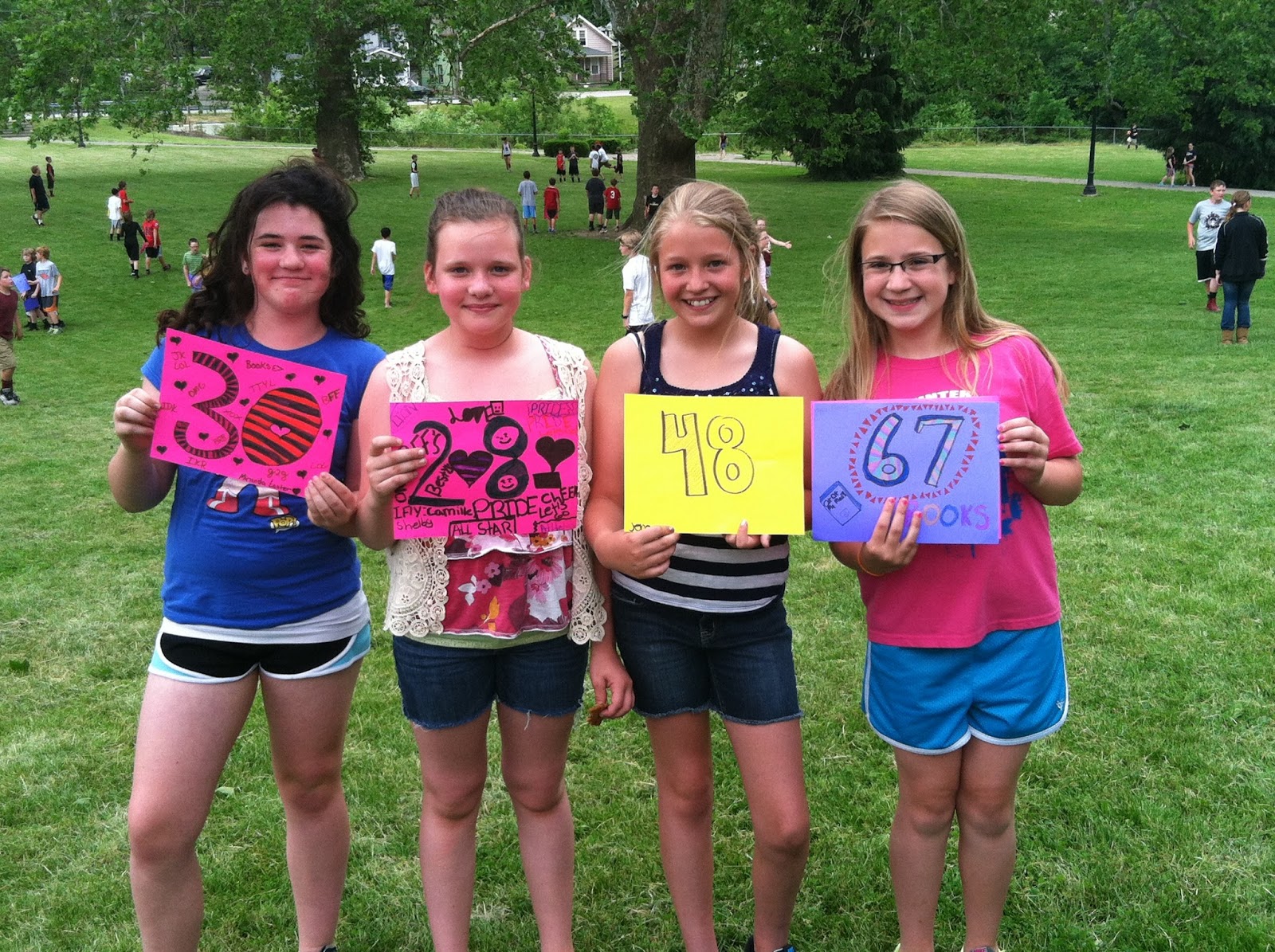
Another school year has come and gone.  This was my first year back full-time since having my daughter (who will be four in August).  I job-shared for three years with the talented Holly Mueller.  You can check out her blog at www.hollymueller.blogspot.com.  In this first year back, I was really able to dig deep and know more about my students and their reading lives.  I started the year by presenting my version of Donalyn Miller's 40 Book Challenge.  I called it the 40 Book Invitation and invited my students to attempt to read 40 books this school year.  I had a wide range of readers, from gifted to emerging.  However, over half of the kids in each class (I teach two LA classes) read 40 books or more.  A significant amount read 30-39 books.  How very exciting!  It was almost unanimous that students read more this year than any other year.  Plus, we all made summer reading lists and talked excessively about summer reading the last few days of school.  And that, my friends, is what teaching reading is all about--a little motivation, mixed with some enthusiasm, and a dash of challenge.  These kids rocked!  (And, I'll really miss getting and giving recommendations from them over the summer!)


Each class read over 1000 books!  AMAZING!!

So, I can't figure out how to rotate this on the blog.  Turn your monitor sideways for a second...

I invite you to entertain the thought of challenging your readers in the upcoming school year.  Do it by page numbers or books, but do it!  Expect them to live a reading life.  They'll surprise you with the their enthusiasm, desire, and results.  Go read books this summer so you can become a "book whisperer" too!  

Sunday, May 19, 2013

Adventure #5-More Conflict, with a Twist

One of our big focuses this year was to take conflict in literature a step further so students could really understand the plot of a novel and then apply it to the world in which they live.  After all, the heart of all disputes is conflict.  And what would good literature be without it?  By being aware of and analyzing conflict, we can better understand the character (s) motivations and why characters act the way they do.  The next step, is to apply that same form of thinking to real life.  Why do people act in certain ways?  What motivates them to respond in the manner they do?  How can we learn about our past by studying the conflicts in it?

This was the premise of the project I created for my accelerated readers.  I knew they could tackle reading an extra book (in addition to their reading contract books--which is a whole other blog entry that I will tackle later).  Students had to choose a historical fiction book about a time period they found interesting.  Many students chose World War Two and the Holocaust.  We've talked about Hitler throughout the year (in our revolutionary thinking unit and in our government unit in Social Studies).  We watched several book trailers on YouTube and I book talked several books in my classroom library--historical fiction happens to be one of my favorite genres.  Students made their book selections and wanted time to read.  When they were done reading, they wrote a book review that focused heavily on the conflict of the story and if they felt the author did an adequate job portraying that conflict through the actions of the characters.  After they read and wrote the book reviews, students then had to find an article relating to the central conflict of their story.  For example, if they read a book about the Holocaust, they had to find an article about the Holocaust.  Students did this through internet searching.  They found some interesting stuff!

Below, I've linked a PowerPoint presentation that one of my students created to share with the class to show the similarities and differences between the book and article and the conflicts each presented.  Students had free range of how to present their findings.  Some did a written report and orally shared their finding with the class, some did PowerPoint presentations and shared with the class, and some created posters to share.  This particular PowerPoint demonstrated the linkage between the book and article quite well for a 5th grader.  I was impressed and so very glad I challenged them to take their learning to the next level!

Check out this great Power Point about the book The Boy Who Dared.  The Boy Who Dared Power Point Presentation


Sunday, April 28, 2013

Adventure #4--Reading Strategies during Read-Aloud

Three years ago I read Writing About Reading by Janet Angelillo (get the book here).
 In it, she talked about having her students respond to her read-alouds on a daily basis.  In years past, I had asked my students to write a response to our read-aloud books about once a month.  The response had to be a paragraph long and it had to contain thoughts and feelings, not a summary.  We had talked about all of the different ways in which you could respond (inferring, predicting, connecting, etc.), but students still struggled with how to apply these things in their writing.  I knew I needed to get them to write more consistently about what they read (I write a book review of each book I read, so you really do use writing about your reading in real life).  I picked up Angelillo's book and instantly found an idea I could take back to my classroom.  She suggested giving students sticky notes to respond on each day.  The idea was, that as I read aloud, students would jot down an inference, or a prediction, or they would make a connection, or they would sketch (for visualization--and let's face it, it's just fun!), or any other number of things we came up with as a class.  The structure was pretty free.  Kids were allowed to try any type of response they wanted, they just had to do one.  After read-aloud was finished for the day, they could share some of their thinking with other classmates.  I made the kids keep the sticky notes in the "Read-Aloud Response" section of their Reader's Notebooks.  This was great for about two months, and then we ran out of room in our notebooks.  Do you know how quickly you can fill up 1/4 of a composition book with sticky notes?  Pretty darn fast!  So, in order to save space and money, we went away from sticky notes and just wrote or drew our thoughts right in the notebook.

Three years later, this is now a daily routine for my classes.  I pass out Reader's Notebooks as soon as they kids enter my room.  Read-aloud is expected each day (usually at the beginning of class) and if, for some strange reason, I don't do it then, there is basically a mutiny in my room and they're ready to throw me overboard and one of them will pick up the book and gladly read to the rest of the gang.  Therefore, we always do read-aloud.  This year, I've read-aloud six books so far (The Miraculous Journey of Edward Tulane, Horton's Miraculous Mechanisms, Liar and Spy, The False Prince, Wonder, and True (...sort of) ).  For each of these books, my students know they have to proffer up some type of response that goes deeper than "I really like/dislike this part...".  We've shared lots of our thinking and have responding to classmates responses.

Because it was test prep week last week (a favorite time for all educators), I thought it would be fun to give each student a sticky note and have them respond.  Before I read aloud, we talked about all of the ways you could respond to a text.  I made a quick graphic organizer on chart paper.  As I read aloud, kids wrote or drew.  When I was finished, they had to stick their response on the graphic organizer.  Here's what it looked like:

Pretty cool, huh?  I was so impressed that the chart had a wide variety of responses.  Personally, I anticipated only prediction and visualization to get all the glory, but they proved me wrong.  We talked about why predictions and visualization get so much attention and is was agreed that those two reading strategies are the easiest for them to "get."  But, we've come a long way this year, as evidenced by the amount of stickies on other areas of the chart.

I've been leading a book study group after school with some fellow teachers, and we're reading a book by Tanny McGregor (a Cincinnati local!) called Comprehension Connections (find it here).  She's suggests offering up concrete examples to get kids better understanding these reading strategies.  So, of course, the old mind is always cranking.  Next year, I anticipate starting the year by spending a few days on each of these strategies, providing some concrete examples to refer back to throughout the year, and then expecting a wide variety of responding and making meaning to be occurring throughout the year.  In the meantime, I'm pretty darn happy with what we've done this year and how our thinking has truly grown.  I don't know that any test can really measure that.

Here's some up-close and personal shots of our responses:This is always a favorite!  Funny how they      mostly drew the same things, though.

                            
 We're currently reading True (...sort of) by Katherine Hannigan.  It lends itself so nicely to empathy.  A great character education lesson there, somewhere...
Wondering is a little more than one question.  These kids really talked it up!


Monday, April 15, 2013

Adventure #3--Conflict in Fiction

So this year my grade level decided to go all-out Common Core for Language Arts.  Yes, we still have the OAA (Ohio Achievement Assessment) for two more years, but we decided to transition in to CCSS so we have a better idea of what our kids (and staff) are expected to do in the upcoming years.  It's been a great transition, filled with much more rigorous work (the chosen word-of-the-moment to describe anything CC).  One of our units consisted of how characters overcome conflict in literature.  Here's my disclaimer for the rest of this post:  No where in the CCSS does it state you have to teach 5th graders about Man vs. Man, Man vs. Nature, Man vs. Unknown, Man vs. Society, or Man vs. Self.  However, a couple of other teachers in my building put together a unit based around these types of conflict, and I thought, "how cool!  My kids could totally do this!".  So, I jumped in and the kids loved it.  They felt very sophisticated when talking about classifying types of problems/conflicts in the books they were reading.  They would disagree with each other and find evidence from the text to support their thinking (gasp--how organic that they learn how to do this, not because I made them do it, but because they wanted to prove they were correct).  Exciting stuff happens in room 100, I'm telling you!

One of the lessons I did with my kids had two purposes.  First, I read aloud a lot of picture books for mini-lessons.  The class loves them!  However, most of my students won't pick them up from our classroom library.  I'm going to say it's because they're always reading novels that they don't want to part from (which is very true), but it's also because I don't give them many opportunities to peruse these fabulous picture books.  Thus, Goal #1: get kids looking at my ever-growing picture book collection.  Goal #2: Identify the conflict in the story, cite evidence from the text to support your claim (is my language impressing you yet?  We really have gone no-holds-bar Common Core, baby!), identify the key players (main characters) in the book and describe their relationship with the conflict.  Also, describe each side of the conflict and tell/explain how it was solved.

Let's look at some action shots of this lesson:


One of our favorite books, I Want My Hat Back by Jon Klassen, was snatched up fast for this project.  Find his book here: I Want My Hat Back


Baloney is another great picture book that can be used for many things (context clues, conflict, setting, etc.).  These two got a kick out of it's nonsensical words.
Find this book here: Baloney


These two kids picked Eats, Shoots and Leaves.  I wasn't sure they would be able to pull it off for conflict, but they did!  What a great way to stretch thinking!


While Coretta Scott is certainly not a fictional picture book, it is beautiful nonetheless.  And, what teacher could tell a kid "no" to nonfiction?!?
Find this book here: Coretta Scott

 Blackout is a fairly new addition to my library (I got it as a Christmas gift).  The illustrations are beautiful and it is told in graphic novel format.  Pretty straightforward conflict, too.
Find this book here: Blackout
 Another nonfiction selection, but again, who am I to deny some quality nonfiction learning?  This is a great one: The Boy Who Invented TV.
Find this book here: The Boy Who Invented TV

This was a win/win for me.  The kids had some quality time reading fun, engaging picture books and they learned a little something about how author's craft their stories around conflict and the solving of it.  How do you approach the subject of conflict in literature?  I'd love some new ideas!  Leave a comment below. :)

Monday, April 1, 2013

Adventure #2--Nonfiction Reading and Writing in 5th Grade

A few weeks ago, my students immersed themselves in nonfiction picture books.  There were many reasons I wanted them to get their hands on some nonfiction.  First, and foremost, because there is some WONDERFUL nonfiction out there right now that is perfect for intermediate grades (4, 5, and 6).  Most of said nonfiction (NF) is in picture book format.  Don't let this dissuade you in its value for children ages 9-12.  Just because the text is accompanied by pictures, doesn't mean it's simplistic in nature!  Some of the NF picture books are quite full of information and require lots of dissection and digestion.  I've found myself buying more and more NF for my classroom library, and our school librarian has made some recent purchases that are right up 5th and 6th graders alleys.  If you're just getting started in your quest for quality NF picture books for intermediate kids, here are some you should check out:

Sit-In: How Four Friends Stood Up by Sitting Down by Andrea Davis Pinkney


Minette's Feast: The Delicious Story of Julia Child and her Cat by Susanna Reich


Manfish: A Story of Jacques Cousteau by Jennifer Berne


Balloons Over Broadway: The True Story of the Puppeteer of Macy's Parade by Melissa Sweet


Bon Appetit! The Delicious Life of Julia Child by Jessie Hartland (apparently I have a thing for Julia!)


Night Flight: Amelia Earhart Crosses the Atlantic by Robert Burleigh


And ANYTHING by Seymour Simon and Steve Jenkins

Once my students had picked a book to dig into deeply, either with a reading partner, or by themselves, they had time to sit and read and enjoy.  As they read, they had post-it notes at-the-ready to document their thinking.  We've practiced "close reading" (a slow version of reading where you focus on what the author is really saying and your thoughts and reactions to it) several times this year.  As my students read, they read closely by documenting their thinking on post its.  Check out the pictures at the end of this paragraph.  After they had read the book and could tell me what they learned from reading the book, they completed a NF flip book assignment.  In this assignment, they had to write a short summary of the book they read, find and copy five facts directly from the text (this get them back into the reading and shows me that they understand what a fact is) and give two of their own opinions about the topic or person about which/whom they read, illustrate their favorite photograph from the text and write why it was their favorite and how it was significant to the text, create five cause/effect statements (because of X, Y occurred), and identify five vocabulary words that were either new to them or that they deemed important to the context of the story.  Below you will see some pictures of their hard work:


                                 An example of close reading a nonfiction book about minerals.


                                                Close Reading and Flip book Examples

I have a few motives for carrying out this project in my room.  The first is to engage and excite kids about reading nonfiction.  They often think they won't like nonfiction, when in fact, they love it!  That is reason enough to give them time to read and think.  The flip book is simply a different format than a worksheet to check for understanding.  The assignment seems a little more broken down for kids and they can pace themselves easily.  They can start on any section they wish and include some of their own thinking in the process.  By the time students are done with this project, they usually want to read more books on the topic they selected!  That's a homeroom in my book!